Salesforce Marketing Cloud SMS Provider Guide: Choosing the Right Partner
Salesforce Marketing Cloud handles email, mobile, ads, and journeys, but it does not actually send SMS messages on its own. You need an SMS provider plugged into the platform to deliver texts to your contacts. That provider handles carrier routing, throughput, number provisioning, and compliance registration. Salesforce gives you the orchestration layer. The provider gives you the pipe. Choosing the wrong provider creates real problems. Messages get delayed during peak sends. Carrier filtering eats your delivery rates. You pay for messages that never arrive. Compliance gaps expose you to TCPA penalties or GDPR violations. The selection process matters because switching providers mid-implementation is expensive and disruptive. This guide walks through what to evaluate when selecting an SMS provider for Salesforce Marketing Cloud. We cover messaging features, integration architecture, security requirements, pricing structures, provider comparison, and implementation steps. The goal is to help you make a grounded decision based on your actual sending patterns, not vendor sales pitches.
Learn how to select the best SMS provider for your Salesforce Marketing Cloud implementation, including key features and considerations.
Introduction to Salesforce Marketing Cloud and SMS
Salesforce Marketing Cloud lets you build customer journeys across email, SMS, push, ads, and web. The platform handles audience segmentation, journey orchestration, personalization, and reporting. But when it comes to SMS, Salesforce does not own the messaging infrastructure.
- You need an external SMS provider connected through Salesforce Mobile Studio or through custom API integrations.
- You buy Marketing Cloud licenses expecting SMS capability, then discover you also need a separate contract with a messaging provider.
- Salesforce does offer MobileConnect as a built-in SMS feature, but it still relies on underlying carrier relationships and routing infrastructure managed by third parties.
This split confuses many operators. The provider you choose determines message delivery speed, throughput capacity, geographic reach, and cost per message. SMS plays a specific role in customer engagement. It gets open rates that email cannot match.
People read texts within minutes. That makes SMS effective for time-sensitive alerts, appointment reminders, authentication codes, and short promotional bursts. But SMS also carries higher per-message costs than email and tighter regulatory requirements. You cannot blast SMS the way you blast email without risking carrier filtering or legal penalties.
Understanding this division of labor helps you evaluate providers correctly. Salesforce Marketing Cloud gives you the orchestration tools. The SMS provider gives you the delivery pipe. Your job is to find a provider whose pipe fits your volume, geography, and compliance needs while integrating cleanly with your Marketing Cloud setup.
Treat the provider decision as an infrastructure choice, not a marketing feature checkbox.
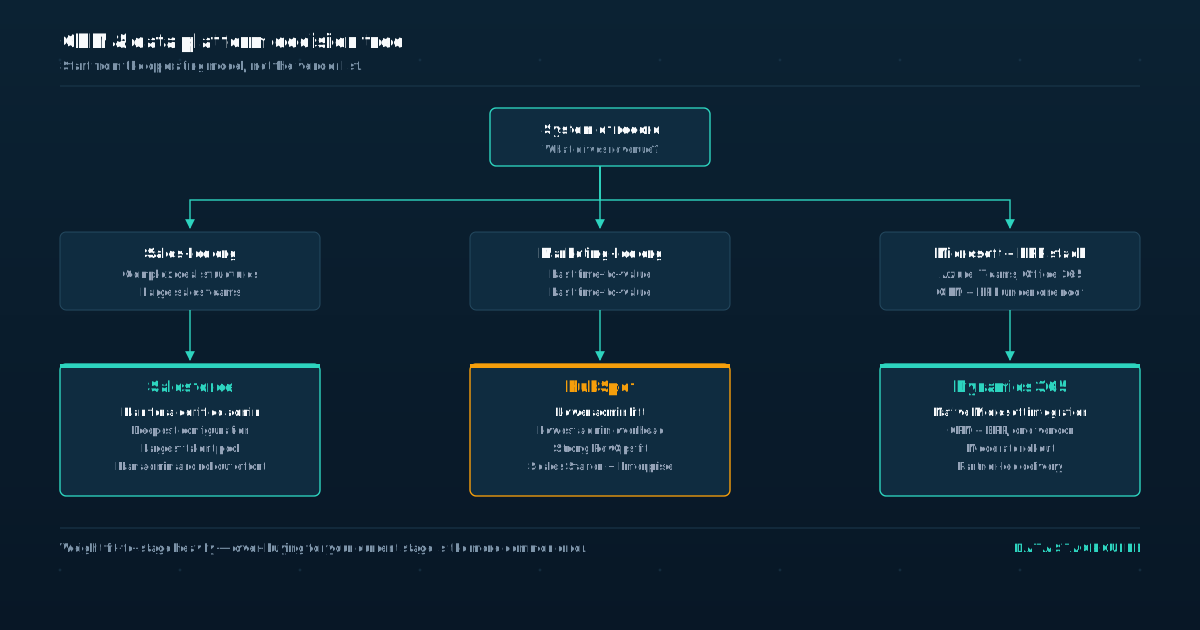
Key Features to Consider in an SMS Provider
Start with throughput. If you send time-sensitive messages like appointment reminders or authentication codes, you need a provider that handles high message-per-second rates without queueing delays. Ask providers about their throughput limits per sender ID or per short code.
- Some providers throttle aggressively during peak periods, which means your messages arrive late or get dropped entirely.
- You need visibility into which messages reached the handset, which bounced, and which got filtered by carriers.
- Some give you real-time delivery receipts with carrier-level error codes.
Next, look at delivery reporting. Providers differ widely here. Others give you batch reports a full day later with vague status descriptions. If you cannot diagnose delivery failures, you cannot fix them.
Global reach matters if you send internationally. Not all providers have direct carrier connections in every country. Some route through intermediaries, which adds latency and cost. Ask for a list of countries where they have direct connections versus partner routes.
Test actual delivery to your target countries before signing a contract. Number types are another consideration. Short codes work for high-volume US messaging but take weeks to provision. Long codes and toll-free numbers provision faster but have lower throughput limits.
Alphanumeric sender IDs work in many countries but not in the US. Your provider should support the number types you need for each market. Finally, check for two-way messaging support if you plan to handle inbound replies, keyword opt-ins, or conversational flows.
Some providers only support outbound messaging, which limits your ability to manage opt-outs and responses inside Marketing Cloud journeys.
Integration with Salesforce Marketing Cloud
Integration architecture determines how smoothly your SMS campaigns run inside Marketing Cloud. Salesforce offers MobileConnect as the native SMS tool, but it still requires a backend provider. Some providers have pre-built packages for Marketing Cloud that install through AppExchange or direct API configuration.
- Others require custom HTTP AMPScript calls or custom journey builder activities built by your development team.
- You get standard send, keyword reply, and opt-out handling out of the box.
- But if you need custom payload structures, advanced personalization, or multi-step conversational flows, you may hit the limits of packaged integrations.
Pre-built integrations save time but limit flexibility. Custom API integrations give you full control but require ongoing maintenance when Salesforce releases platform updates. Data synchronization is the next concern. Your SMS provider needs access to contact data stored in Marketing Cloud data extensions.
How does the provider pull mobile numbers, consent flags, and personalization fields? Some integrations push data in real time through journey builder activities. Others require batch exports on a schedule, which creates lag between when a contact opts in and when they receive their first message. Ask about error handling and retry logic.
What happens when a send fails inside a journey? Does the provider queue and retry, or does the message get lost? Can you view failed sends inside Marketing Cloud, or do you need to log into a separate provider dashboard? These operational details matter when you are troubleshooting a broken journey at odd hours.
Test the integration with a small pilot before full rollout. Send to a few hundred contacts, check delivery rates, verify opt-out handling, and confirm reporting flows back into Marketing Cloud dashboards.
Security and Compliance Considerations
SMS marketing carries legal risk. In the US, the TCPA governs text message marketing and requires explicit consent before sending promotional messages. In Europe, GDPR governs personal data processing, including phone numbers.
- Your SMS provider plays a role in compliance, but the legal responsibility sits with you as the sender.
- Check whether your provider offers consent management tools.
- Some providers store opt-in records with timestamps and source attribution, which helps if you face a TCPA complaint.
Violations lead to fines and lawsuits. Others leave consent tracking entirely to you. If you rely on Marketing Cloud for consent data, make sure the provider can read and respect opt-out flags in real time. Sending to a contact who opted out minutes ago is a compliance failure.
Data encryption matters for any provider handling phone numbers and message content. Ask about encryption at rest and in transit. Ask where data is stored geographically, since GDPR has data residency requirements for EU personal data. Some providers store logs for a month, others for a year or longer.
Longer retention helps with audit trails but increases exposure if the provider suffers a breach. A2P 10DLC registration is now required for US application-to-person messaging over standard long codes. Your provider should handle this registration on your behalf or guide you through the process.
Providers that ignore 10DLC requirements put your delivery rates at risk, since carriers filter unregistered traffic aggressively.
Review the provider's own compliance certifications. SOC 2 Type II, ISO 27001, and signed DPAs for GDPR are standard expectations. If a provider cannot produce these documents, treat that as a red flag regardless of their pricing or feature claims.
Pricing Models and Cost Considerations
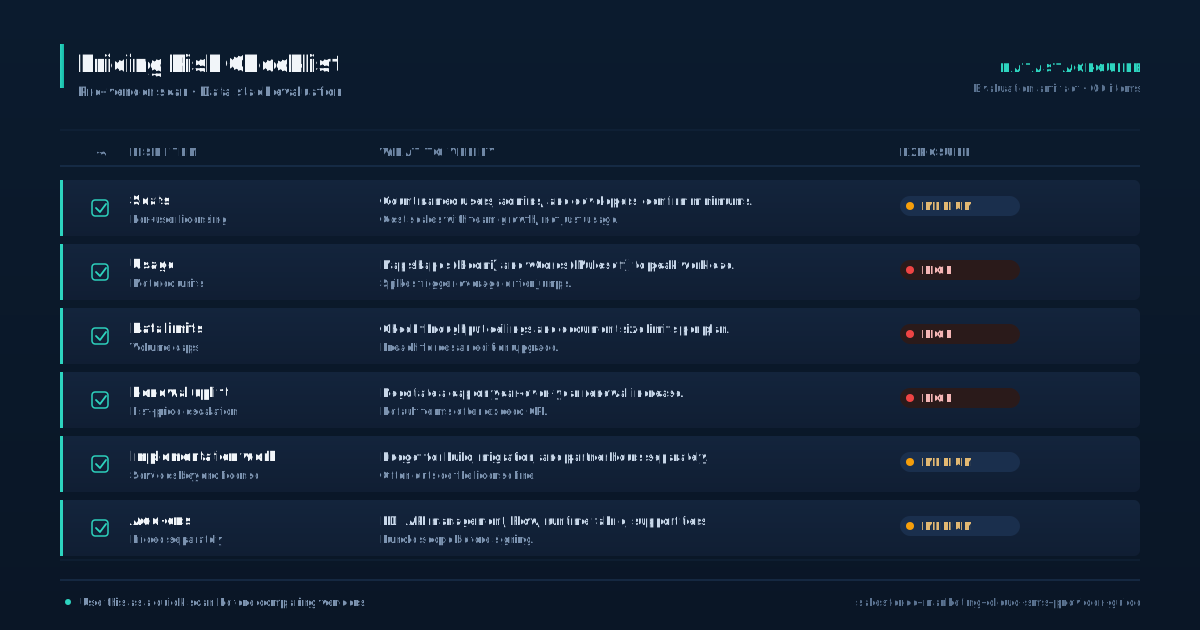
SMS pricing is deceptively complex. Most providers charge per message, but the per-message rate varies by destination country, number type, and message length. A message to a US number costs less than a message to a UK number, which costs less than a message to a Brazilian number.
- Unicode characters, which include emojis and non-Latin scripts, split a single message into multiple billed segments.
- The same length in Unicode can be several segments.
- Ask providers for a clear rate sheet covering every country you plan to send to.
A standard Latin message is one segment. Watch for hidden fees beyond per-message rates. Short code leasing fees, toll-free number verification fees, A2P 10DLC campaign registration fees, and platform access fees all add up. Some providers charge a monthly minimum regardless of usage.
Others charge for inbound messages separately from outbound. Volume discounts are common but often tiered in ways that do not match your actual sending pattern. A provider offering discounts above six figures per month does not help if you send far less. Model your monthly costs based on realistic volume estimates, not best-case projections.
Compare providers on total cost of ownership, not headline rates. One provider charges a slightly higher per-message rate with no platform fee. Another charges less per message but adds a monthly platform fee. At lower volumes, the first provider costs less overall.
At higher volumes, the second becomes cheaper. Run the math for your actual sending pattern. Ask about currency conversion fees if you are billed in a currency other than your own. These fees are rarely disclosed upfront and can add several percent to your actual costs.
Evaluating SMS Provider Options
Several providers dominate the Salesforce Marketing Cloud SMS landscape. Twilio is the most common choice, with a pre-built integration and strong developer documentation. Twilio offers direct carrier connections in most markets, real-time delivery receipts, and support for short codes, long codes, and toll-free numbers.
- Its pricing is transparent but adds up quickly for high-volume senders.
- Twilio also owns Segment, which creates overlap if you use Marketing Cloud for audience management.
- Vonage, formerly Nexmo, is another option with a Marketing Cloud integration package.
Vonage offers competitive per-message rates and solid global coverage. Its documentation is less polished than Twilio's, and the Marketing Cloud integration requires more configuration effort. Vonage works well for senders who need international reach at lower cost and have technical resources to handle setup.
Sinch is a third major player, particularly strong in Europe and emerging markets.
Sinch acquired several regional providers, which gives it direct carrier relationships in markets where Twilio and Vonage rely on partner routes. Sinch's Marketing Cloud integration is less standardized, often requiring custom API work. Bandwidth. Com is a US-focused provider that owns its own carrier network.
This gives Bandwidth strong delivery rates and cost control for domestic US messaging. Bandwidth is less suited for global senders but attractive for US-only operations. MessageBird and Clickatell are additional options worth evaluating depending on your geography and use case. Both offer global reach but differ in integration depth with Marketing Cloud.
Do not pick a provider based on brand recognition alone. Run a structured comparison: coverage map, per-country rates, integration method, compliance support, and reference customers in your industry. Ask for a paid pilot before committing to an annual contract.
Best Practices for Implementing SMS with Salesforce Marketing Cloud
Start with a clear use case. SMS is expensive relative to email, so reserve it for messages where speed and open rates justify the cost. Appointment reminders, order status updates, authentication codes, and time-sensitive alerts are strong use cases.
- Generic promotional blasts are weak use cases unless you have a specific audience segment that responds well to SMS.
- Short codes in the US take several weeks to approve through carrier review.
- Toll-free numbers are faster but still require verification.
Provision your numbers early. A2P 10DLC campaign registration takes days to weeks. If you wait until launch to provision numbers, you will miss your go-live date. Start the provisioning process the day you sign the provider contract.
Build consent capture into every entry point. Web forms, in-store signups, and email cross-promotions should all include a clear SMS opt-in with disclosure language. Store consent records with timestamps in Marketing Cloud data extensions. Your SMS provider should read these records before sending.
Do not rely on manual opt-out lists maintained outside the platform. Test with a small audience first. Send to a hundred internal contacts, verify delivery, check formatting on different devices, and confirm opt-out handling works. Then expand to a thousand contacts, then scale up.
Watch delivery rates at each stage. If delivery drops as volume increases, you have a throughput or carrier filtering problem that needs fixing before full rollout. Monitor delivery rates weekly after launch. Set up alerts for delivery rate drops below your baseline.
Review carrier-level error codes regularly. If a specific carrier starts filtering your messages, you need to catch it early and work with your provider to resolve the issue. Ignored delivery problems compound over time and damage your sender reputation.
Decision Framework and Next Steps
Use a structured evaluation process rather than picking the first provider a Salesforce account manager recommends. Build a scoring sheet with weighted criteria based on your specific needs. If you send most messages domestically in the US, weight domestic delivery rates and 10DLC support heavily.
- If you send globally, weight country coverage and direct carrier connections.
- If you run complex journeys with real-time triggers, weight API latency and integration depth.
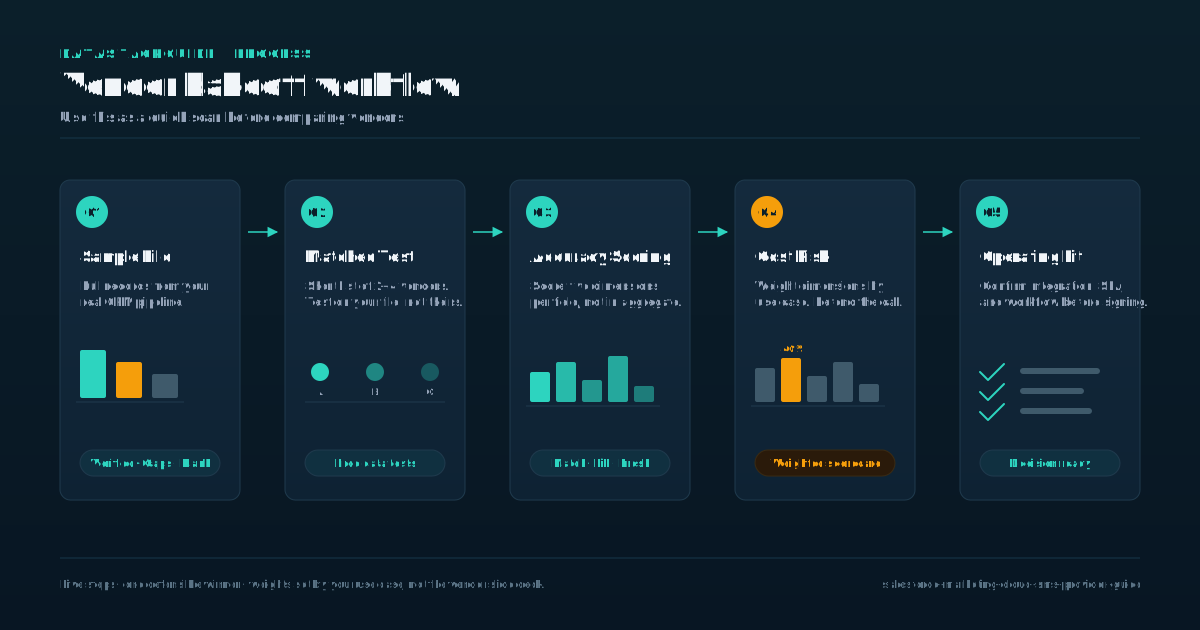
- Narrow to three providers and run parallel pilots.
Send the same message content through each provider to the same audience segment, split into thirds. Compare delivery rates, latency, cost per delivered message, and error rates. This gives you real data instead of vendor demos. Negotiate contracts based on your pilot results.
If a provider knows you are evaluating competitors, they are more likely to offer volume discounts or waive platform fees. Ask for an annual contract with an exit clause if delivery rates fall below an agreed threshold. Do not sign a multi-year contract on your first provider relationship.
Plan for provider switching as a possibility, even if your initial choice works well.
Document your integration architecture, consent data flows, and number provisioning details. If you need to switch providers down the road, having clean documentation reduces migration time from months to weeks.
Your next steps: map your sending volumes by country, list the number types you need, define your consent capture process, and request rate sheets from three providers. Run a pilot.
Make a decision based on data, not vendor relationships. The right SMS provider for Marketing Cloud is the one that delivers your messages reliably at a cost you can justify, with compliance you can prove.
Sources
Frequently Asked Questions
What is the difference between a dedicated and shared SMS short code?
A dedicated short code is assigned to a single organization, while a shared short code is used by multiple organizations. Dedicated short codes offer more control and flexibility, but may be more expensive.
Can I use a third-party SMS provider with Salesforce Marketing Cloud?
Yes, Salesforce Marketing Cloud supports integration with third-party SMS providers through APIs and other connectivity options.
How do I ensure compliance with SMS regulations, such as TCPA and GDPR?
Work with an SMS provider that offers security and compliance features, and implement practices such as obtaining explicit consent from recipients with timestamps. Store consent records in Marketing Cloud and ensure your provider reads opt-out flags in real time.
What is the typical cost of sending SMS messages through Salesforce Marketing Cloud?
The cost varies depending on the SMS provider, messaging volumes, destination countries, and number types. Evaluate per-message rates, platform fees, number leasing fees, and registration fees. Model your monthly costs based on realistic volume estimates.
Can I use Salesforce Marketing Cloud to send SMS messages globally?
Yes, Salesforce Marketing Cloud supports global SMS messaging, but you need an SMS provider with direct carrier connections in your target countries. Test actual delivery to each country before signing a contract.