Is Salesforce Marketing Cloud Any Good? An Operator Review
Salesforce Marketing Cloud is one of the most recognizable enterprise marketing platforms on the market, but name recognition is not the same as fit. For operators evaluating whether to adopt, renew, or migrate away from it, the real questions are narrower: does it handle the channels you actually run, can your team administer it without a permanent consultancy, and does the cost make sense relative to outcomes. This guide walks through what Marketing Cloud does well, where it creates friction, and how to pressure-test vendor claims before signing a multi-year contract. The goal is not to settle whether the platform is universally good or bad. No tool is. The goal is to help you decide whether it fits your stack, your team capacity, and your data maturity, or whether a simpler set of tools would serve you better at lower cost and complexity.
A practical, skeptical look at Salesforce Marketing Cloud: where it fits, where it struggles, and how to decide if it is worth the complexity for your stack.
What Salesforce Marketing Cloud Actually Is
Before evaluating Marketing Cloud, operators need to understand what they are actually buying. Marketing Cloud is not a single application. It is a suite of modules built around different marketing functions, and Salesforce bundles them differently across editions and contracts.
- Each of these can be licensed separately or grouped, which makes apples-to-apples comparison between vendors difficult when you are looking at feature lists alone.
- A common source of confusion is the relationship between Marketing Cloud and Marketing Cloud Account Engagement, which was previously called Pardot.
- They are different products aimed at different use cases.
The core modules include Email Studio for email design and sending, Mobile Studio for SMS and push, Advertising Studio for audience activation across ad platforms, Journey Builder for multi-step orchestration, Content Builder for asset management, Audience Builder for segmentation, and Personalization, which was formerly called Interaction Studio.
Account Engagement is oriented toward B2B lead nurturing and scoring, while the broader Marketing Cloud suite is built for larger, multi-channel marketing operations with more complex journey orchestration needs. Buyers frequently conflate the two, and vendor proposals sometimes blur the distinction.
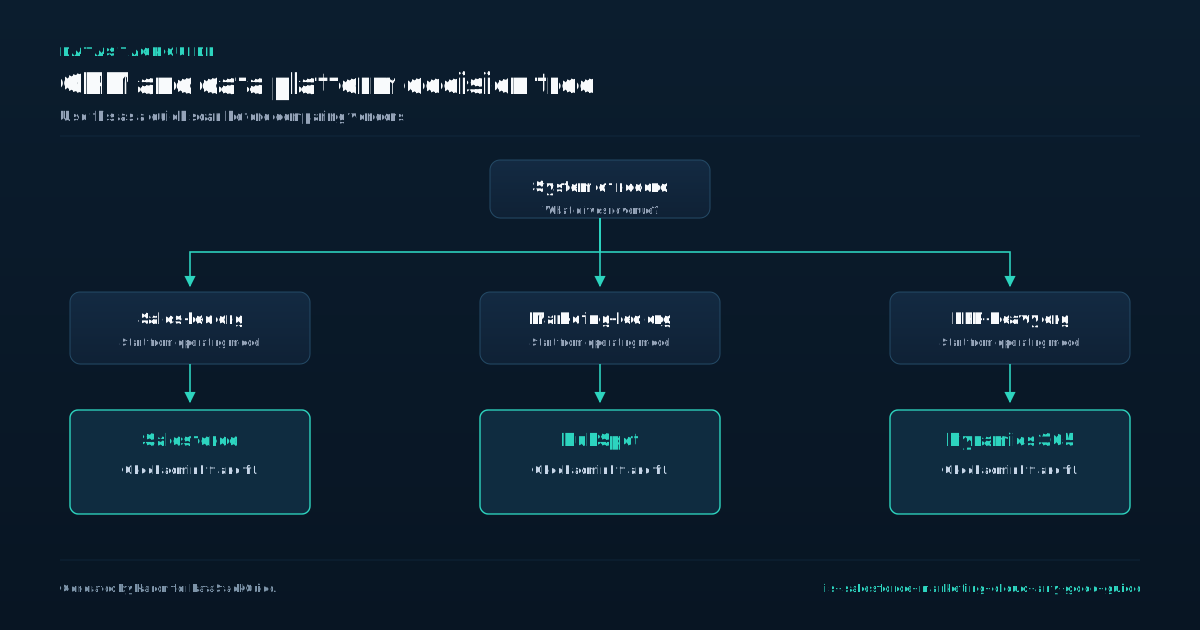
The practical takeaway for operators is this: before reading any feature list or watching any demo, map the modules to the channels you actually run. The platform is broad and modular, and it is priced accordingly.
Understanding which modules you need, and which you do not, is the first step toward evaluating whether Marketing Cloud is worth the investment for your specific situation. If a vendor proposal bundles modules you cannot name a use case for, that is a signal to slow down and ask harder questions before contracting.
Where Marketing Cloud Genuinely Works Well
Marketing Cloud earns its reputation in specific scenarios, and it is worth being direct about where it performs. For large organizations that already run Salesforce Sales or Service Cloud, the integration between CRM and marketing automation is a real advantage.
- Contact data, campaign membership, lead status, and custom objects flow into Marketing Cloud through synchronized data extensions, and journey triggers can fire based on CRM events without middleware.
- That tight coupling reduces friction for teams who would otherwise build and maintain custom integrations between separate platforms.
- Journey Builder is a genuine strength when teams have the resources to design, test, and maintain multi-step journeys.
Branching logic, wait periods, exit criteria, and channel sequencing are all configurable within a single canvas, which is more manageable than stitching together separate tools for email, SMS, and ad audiences.
For high-volume email sends, the platform scales reliably and supports governance features that matter in regulated industries, including consent management, unsubscribe handling, and audit trails. Reporting and audience segmentation also improve significantly when CRM data is already clean and centralized in Salesforce.
The platform can segment based on CRM fields, engagement history, and custom attributes without exporting data to a third-party tool. None of this works well if the underlying CRM data is messy or incomplete. Marketing Cloud amplifies whatever data quality you bring to it.
If your Salesforce org is well-governed and actively maintained, Marketing Cloud can deliver real operational value. If it is not, the platform will expose those gaps quickly and painfully.
Where It Creates Pain
Implementation timelines are long, often measured in months rather than weeks. Data extensions require deliberate modeling and ongoing maintenance, and getting the structure wrong early creates technical debt that compounds over time. The interface is not intuitive for casual users.
- Teams frequently end up dependent on certified consultants or internal specialists for tasks that would be self-service in simpler tools.
- AMPscript, the scripting language used for dynamic content in Email Studio, has a learning curve that surprises teams coming from platforms with visual editors.
- Writing queries against data extensions requires familiarity with SQL syntax and the platform's specific data model.
SQL within Marketing Cloud is another barrier. For teams without a marketing ops function, this is a real constraint, not a minor inconvenience. Simpler email platforms often cover the same ground with visual builders and prebuilt templates. Support experiences vary.
Enterprise support tiers exist, but response quality and resolution times are inconsistent. Operators should not assume that paying for a higher support tier guarantees fast, knowledgeable help. Many teams rely on community forums, partner consultancies, and internal documentation to solve problems. The pain here is operational, not just financial.
Every journey change, data extension update, or segmentation query can become a ticket. Over time, teams accumulate workarounds and undocumented processes that make the platform harder to maintain and harder to hand off.
If your team does not have someone who owns Marketing Cloud administration as a significant part of their role, the platform will degrade into a source of friction rather than a source of value.
Pricing and Contract Realities
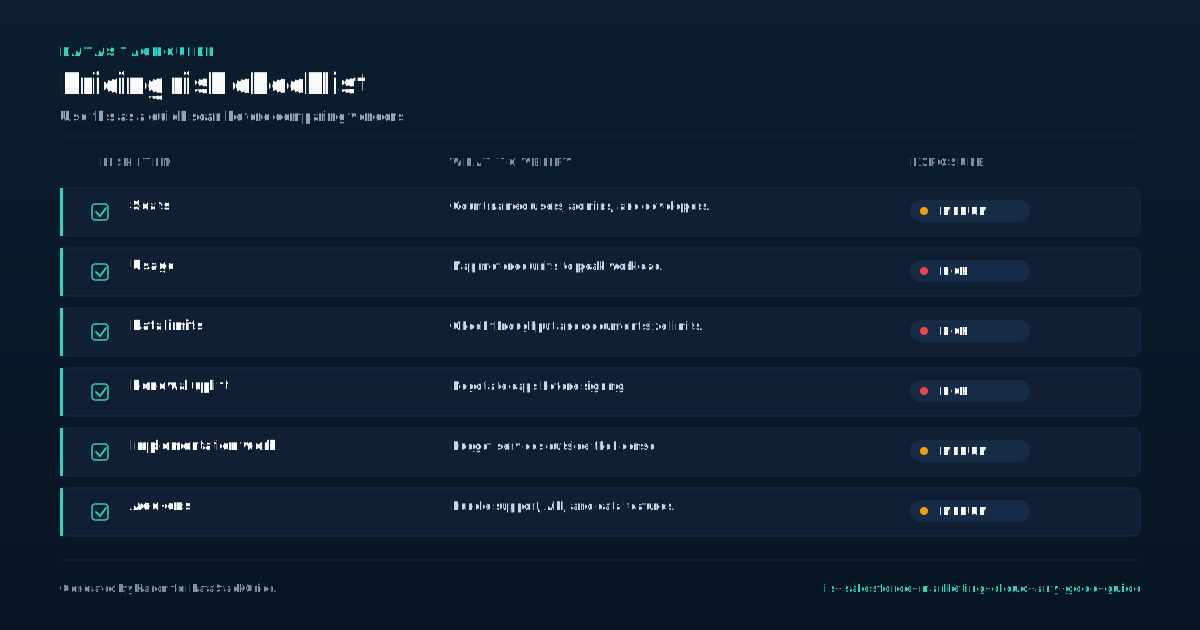
Pricing is hard to evaluate without a quote. Salesforce does not publish list pricing for Marketing Cloud, and contracts vary based on modules, send volume, contacts, and add-ons. This means two organizations of similar size can pay very different amounts depending on negotiation, bundle structure, and timing.
- Operators should not assume any quoted price is fixed.
- Discounts and terms are often negotiated, especially for multi-year deals or organizations with existing Salesforce relationships.
- A common pattern is starting with a narrow bundle and expanding later.
This sounds reasonable in theory, but module-by-module expansion can quietly increase total cost. A team that begins with Email Studio and Journey Builder may find they need Mobile Studio, Advertising Studio, or Personalization within a year. Each addition comes with its own licensing, implementation, and training costs.
The result is a platform that looked affordable at signing but grows well beyond the original budget. Before contracting, map required modules to actual use cases. Question any vendor proposal that bundles capabilities the team will not use in year one.
If a module does not have a named owner and a defined use case, push back. Ask for pricing on each module separately so you can see what you are paying for and what you could defer. Also model the cost of implementation, consulting, and internal staffing alongside license fees.
The total cost of ownership over three years is the number that matters, not the annual license quote. If implementation and consulting costs approach or exceed the license cost in year one, that tells you something about the platform's operational weight.
Integration with the Wider Salesforce Stack
Marketing Cloud's tightest integrations are with Salesforce CRM, and that is a genuine advantage for organizations already on Sales or Service Cloud. Synchronized data extensions can pull contact records, lead records, and custom objects from CRM into Marketing Cloud on a scheduled or triggered basis.
- Journey Builder can listen for CRM events like opportunity stage changes, case closures, or custom field updates, and use those events to trigger messages or branch logic.
- For teams whose customer data lives in Salesforce, this integration reduces the need for middleware and custom development.
- Field mappings need to be set up and maintained.
But synchronization is not automatic magic. It requires configuration, monitoring, and data governance. Sync errors can occur when fields are renamed, objects are restructured, or data types change. Teams need someone who understands both the CRM data model and the Marketing Cloud data extension structure to keep the integration healthy.
For non-Salesforce systems, the story is different. Connectors exist for common platforms, and the Marketing Cloud API is documented, but integrations with external CRMs, data warehouses, or event systems often need middleware or custom development. This adds cost, complexity, and maintenance burden.
If your CRM is not Salesforce and you do not plan to migrate, much of the platform's differentiation weakens. You would be paying for integration advantages you cannot use without additional engineering work. This is a decision point, not a footnote.
If your CRM is elsewhere, evaluate whether the integration cost and effort are justified, or whether a marketing platform with native connectors to your existing stack would deliver similar outcomes with less overhead.
Personalization and AI Claims
Salesforce positions Einstein and personalization features as a differentiator, and these capabilities are prominent in demos and sales conversations. Operators should approach these claims with specific questions. What data is required for the AI features to function?
- What outcomes are actually measured, and how does the platform report on them?
- Without clear answers, AI features risk becoming shelfware that sounds impressive in a demo but never delivers measurable results in production.
- Personalization features depend on unified identity, clean event data, and consistent consent management.
How are models trained? If your customer data is fragmented across systems, identity resolution is incomplete, or event tracking is inconsistent, AI recommendations tend to underwhelm. The platform can only work with the data it receives. Garbage in, garbage out applies here as much as anywhere.
There is also a meaningful difference between real-time personalization and batch segmentation. Some Marketing Cloud personalization features operate in real time, adjusting content based on current session behavior. Others rely on batch processing, where segments are built and refreshed on a schedule.
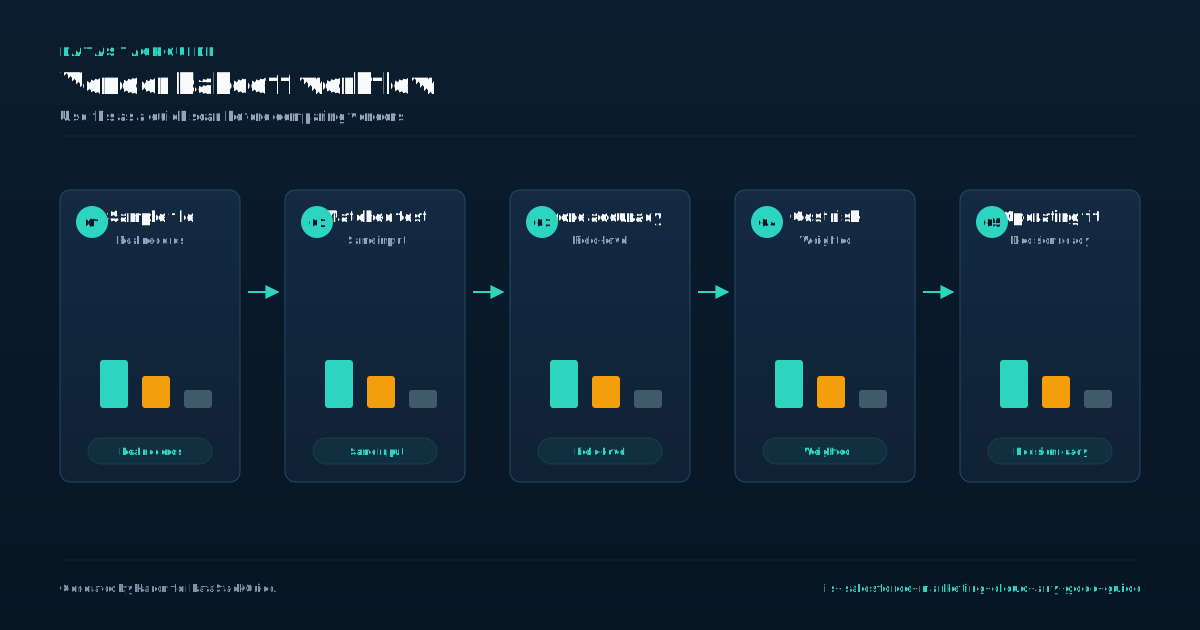
Understanding which mode you are operating in matters for use cases like cart abandonment, price changes, or inventory alerts, where timing affects outcomes. If you are buying the platform primarily for AI, pressure-test that use case before signing. Ask for a proof of concept using your own data, not a generic demo dataset.
If the vendor cannot demonstrate the AI features working on your data with your current data quality, treat the claims as aspirational rather than proven. AI is a capability, not an outcome, and capabilities only matter if your organization can operationalize them.
When You Should Probably Not Choose It
Marketing Cloud is likely overkill for small marketing teams, single-channel programs, or organizations without a dedicated ops function. If your team consists of a few marketers who also handle other responsibilities, the administrative burden of Marketing Cloud will compete with actual campaign work.
- Data extensions, journey maintenance, AMPscript, and SQL queries all require specialist knowledge or significant training time.
- Teams that cannot commit to that investment will struggle to get value proportional to the cost.
- It is also a questionable fit for organizations whose CRM is not Salesforce and who do not plan to migrate.
Much of the platform's value proposition rests on tight CRM integration. Without that integration, you are left with a capable but complex marketing tool that requires more effort to connect to your existing systems than alternatives built with broader connector ecosystems.
For teams with simpler needs, a focused email platform, a separate SMS tool, or a lighter journey orchestration layer may deliver similar outcomes with less overhead.
If your marketing program is primarily batch-and-blast email with basic segmentation, a tool like Mailchimp, Klaviyo, or Braze may cover your needs at a fraction of the operational cost. If your journeys are linear and do not require cross-channel branching, a simpler automation tool may suffice.
The decision should start with your must-have channels and your actual journey complexity. Document what you run today, what you plan to run in the next twelve months, and what your team can realistically administer. Then compare Marketing Cloud against simpler stacks on those dimensions. Marketing Cloud is not universally bad.
It is a tool with a specific operational profile, and it fits organizations that match that profile. For organizations that do not, the cost and complexity will outweigh the benefits.
How to Evaluate It for Your Team
Start by documenting your current channels, send volumes, data sources, and team capacity. This sounds obvious, but many organizations skip it and end up evaluating platforms against feature lists rather than against their own operations. Write down what you send, how often, to whom, through which channels, and what data drives those decisions.
- Require a sandbox or trial environment, not just a demo.
- Demos are curated to show the platform at its best.
- A sandbox lets you test at least one real journey end to end, from trigger to send to reporting.
This becomes your evaluation baseline. If the vendor resists providing a sandbox, that is a signal. Ask why, and weigh the answer carefully. Ask for references in similar industries and similar team sizes, not just flagship enterprise logos.
A reference call with a company of your size in your industry will tell you more about day-to-day operations than a case study featuring a global brand with a dedicated marketing ops team. Map required modules to use cases and get pricing for each separately. This prevents bundle creep and strengthens your negotiating position.
Involve data and CRM owners early in the evaluation. Marketing Cloud success depends on data governance, and if those teams are not part of the conversation, you will discover integration problems after signing. Finally, model the total cost of ownership over three years. Include license fees, implementation, consulting, internal staffing, and training.
Compare that number against the cost of simpler alternatives. If the gap is large, ask whether the additional capabilities justify the additional cost. If you cannot name specific journeys, channels, or data use cases that require Marketing Cloud, the answer is probably no.
Sources
Frequently Asked Questions
Is Salesforce Marketing Cloud the same as Pardot?
No. Pardot is now called Marketing Cloud Account Engagement and is aimed more at B2B lead nurturing and scoring.
Marketing Cloud, sometimes referred to as Marketing Cloud Engagement or the broader Marketing Cloud suite, is oriented toward larger, multi-channel marketing operations with more complex journey orchestration needs.
Do you need a Salesforce CRM license to use Marketing Cloud?
No, but the integration advantage is much weaker without it. Marketing Cloud can connect to other systems through APIs and connectors, but the tightest data sync and journey triggers come from Salesforce Sales or Service Cloud.
If your CRM is elsewhere, evaluate whether the added integration work is worth it.
How long does implementation usually take?
Implementation timelines vary, but for enterprise deployments it is common to hear of multi-month projects covering data modeling, journey design, integration, and user training. Smaller scoped rollouts can move faster, but operators should not assume a quick turn-up.
Treat implementation as a real project with dedicated resources.
Can a small marketing team use Marketing Cloud effectively?
It is possible but often not advisable. The platform assumes a certain level of operational maturity and specialist support.
Small teams without dedicated marketing ops resources frequently struggle with administration, data extensions, and journey maintenance, and may get better value from simpler tools.
Does Marketing Cloud include AI personalization out of the box?
AI and personalization features are available, but they are not plug-and-play. Effective use depends on clean data, unified identity, consistent consent, and ongoing model oversight.
Treat vendor AI claims as capabilities to validate against your data maturity, not as automatic outcomes.