How to Run a Data Vendor Bakeoff That Produces a Clear Winner
Most teams pick their data provider based on a sales demo and a pricing sheet. Then six months later they are stuck in a contract with poor match rates on their target segment and no way out until renewal. A vendor bakeoff fixes this by forcing providers to prove their data quality on your actual records before you sign anything. The process takes a few weeks, costs nothing because every major provider will run a free test, and saves you from a costly mistake. The framework is straightforward: pull a representative test file from your CRM, send it to a short list of vendors, score the results on dimensions that matter to your use case, and negotiate with evidence in hand. This guide walks through each step from building the test file to setting a review cadence after you sign. The goal is a decision you can defend to your VP of Sales and your finance team. No more guessing based on demo data.
A step-by-step framework for testing B2B data providers against your real data. Sample sizes, scoring criteria, and timelines that produce definitive results.
Build Your Test File From Your Real Pipeline
Do not let vendors test on their own sample data. That is a controlled environment designed to make them look good. You need to test on records that represent your actual prospecting targets.
- Pull contacts from your CRM that match your ideal customer profile.
- Include a mix: records you know are accurate with verified emails and confirmed phone numbers, records with gaps where phone is missing or email is outdated, and records where you have zero enrichment data.
- This three-way split lets you measure match rate, accuracy, and net-new fill rate independently.
Each bucket tests a different vendor capability, and lumping them together hides where a provider is actually strong or weak. Make sure the test file represents your real segments. If you sell to mid-market healthcare companies in the US, your test file should reflect that.
A vendor might have strong coverage on enterprise tech companies and weak coverage on mid-market healthcare.
The aggregate number hides this gap. Pull records from the industries, company sizes, and geographies you actually target. Strip out any existing enrichment data before sending to vendors. You want them starting from the same baseline: company name, contact name, and company domain.
If you send pre-enriched records, you cannot tell whether the vendor found the data independently or just confirmed what you already had. The test only works if every vendor starts from the same raw inputs. Keep the file size manageable.
A few hundred records gives you enough volume for statistical reliability without making vendors push back on free testing.
Too few records and noise dominates. Too many and the manual verification step becomes a burden your team will rush through or skip entirely.
Select a Short List and Request Matched Tests
Do not test more than four providers. The comparison becomes unmanageable, and you will spend more time analyzing results than making a decision. Pick two serious contenders and one dark horse.
- The dark horse is a vendor you are curious about but have not fully evaluated.
- Sometimes they surprise you, and sometimes they confirm your suspicions.
- When you contact vendors, be direct: you are running a competitive evaluation with a specific timeline.
Either way you learn something. Most providers have a formal bakeoff process. Major providers like ZoomInfo, Apollo, Cognism, and smooth. Ai all offer free data tests for qualified prospects.
Some will push back and try to funnel you into a demo-first process. Push through this. You do not need another demo. You need matched data returned against your file.
Send each vendor the same test file on the same day. This eliminates any time-based data freshness advantage. Request results within a week. Vendors who cannot turn around a modest test in that window are showing you what their support responsiveness will look like post-sale.
If they are slow before you pay them, they will be slower after. Ask each vendor to return the same fields: direct dial phone, mobile phone, work email, personal email, job title, company size, industry, and LinkedIn URL. Standardize the request so you are comparing identical outputs.
If a vendor cannot return a specific field, note it.
Missing fields are a data point, not an inconvenience. Tell every vendor they are in a competitive evaluation. Transparency motivates them to deliver their best results and respond faster. It also sets the expectation that you are making a data-driven decision, which helps when you negotiate pricing later.
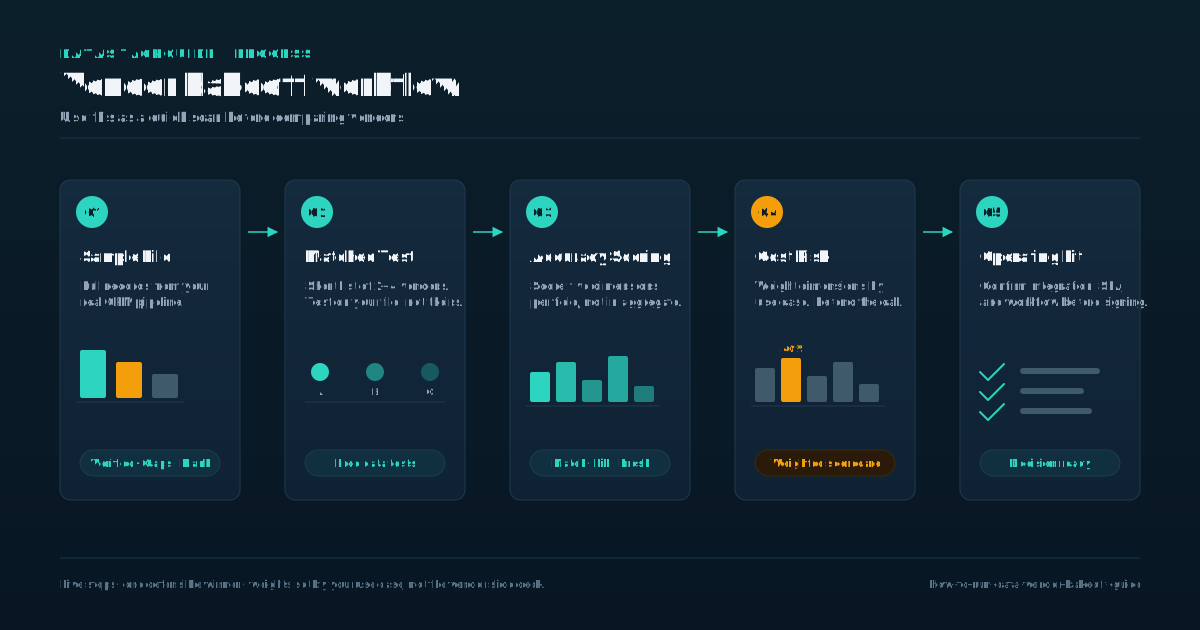
Score Results Across Five Dimensions
Match rate is the obvious metric but it is not enough. A vendor can have a high match rate and still be terrible if half those matches are wrong. Score each vendor on five dimensions so you get a full picture of what they actually deliver.
- Match rate: what percentage of your records did they return data for?
- Email match rate, phone match rate, title match rate.
- A vendor with strong email match rate but weak phone match rate has a different profile than one with moderate coverage on both.
Measure this per field. The per-field breakdown tells you where each provider is strong and where they are padding numbers. Accuracy: take a random sample of returned records and manually verify them. Call the phone numbers.
Send test emails. Check LinkedIn profiles against returned titles. This is tedious but it is the only way to know if the matched data is correct. Do not skip this step.
A high match rate with low accuracy is worse than a moderate match rate with high accuracy because your reps will waste time calling dead numbers. Fill rate on gap records: of the records with missing data, how many gaps did each vendor fill?
This measures their ability to add value beyond what you already have. Net-new discovery: of the records with zero data, how many did each vendor enrich from scratch?
This matters if you are using the provider for prospecting, not just enrichment. Data freshness: ask each vendor for the last verified timestamp on returned records. If they cannot provide this, that is a red flag. Old data decays.
You need to know how stale the records are before you rely on them for outreach.
Build a Weighted Scorecard Your Team Can Defend
Create a simple spreadsheet with your five dimensions as columns and vendors as rows. Do not weight all dimensions equally. Your use case determines the weights, and getting the weights right is what turns a pile of numbers into a decision.
- If you are building prospecting lists, weight net-new discovery and match rate highest, accuracy slightly below those, and fill rate and freshness lower.
- If you are enriching existing CRM records, weight accuracy highest, fill rate next, match rate below that, freshness moderate, and net-new lowest.
- The weights reflect what your team actually needs from the data, not what looks good on a vendor slide deck.
Score each dimension on a simple scale. Multiply by weight. Sum the weighted scores. This produces a single number per vendor that accounts for your specific priorities.
The math is simple enough that anyone can audit it, which matters when your VP of Sales asks why you picked one vendor over another. You should be able to explain the decision in under a minute. Share the scorecard with stakeholders before you announce results. Let people challenge the weights.
It is better to debate the methodology upfront than to have someone undermine the decision after the contract is signed. If sales wants match rate weighted higher and ops wants accuracy weighted higher, have that conversation before the scores are final. Document the scoring process.
Write down why each weight was chosen and what data drove the final decision.
When renewal time comes, you will want to look back at the original scorecard and compare it to actual performance. If the vendor that won on match rate turned out to have poor accuracy in practice, you adjust the weights next time. The scorecard is a living document, not a one-time exercise.
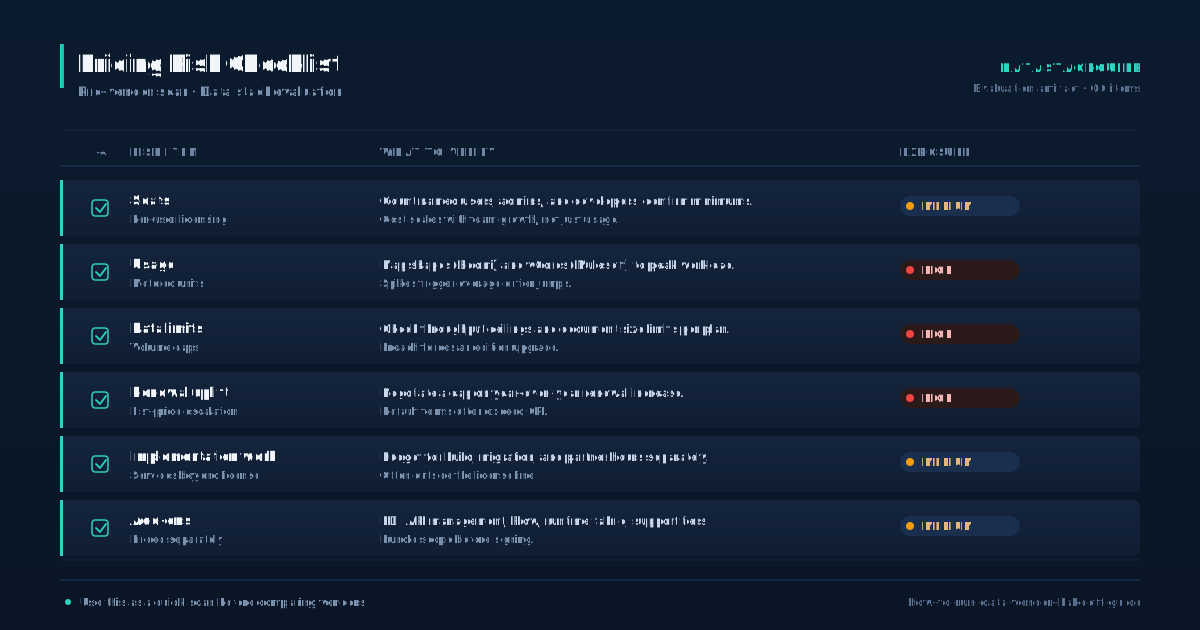
Test the Integration Before You Commit
Data quality is necessary but not sufficient. A provider with great data and a broken CRM integration will cause more problems than a provider with good data and a smooth sync. During the bakeoff period, have your ops team test the integration path in parallel with the data evaluation.
- Connect the provider to your CRM in a sandbox environment.
- Run a small enrichment batch through the native integration.
- Check: did the data land in the right fields?
Did it overwrite existing data you did not want overwritten? Did it create duplicates? How did it handle records that already existed? These are the questions that determine whether the tool is usable day to day.
A vendor might have excellent data quality but a poorly built integration that creates chaos in your CRM and erodes trust in the data over time. Test the API if you plan to use it. Run lookups through the API and measure response time, rate limits, and error handling.
Some vendors have great web interfaces but APIs that throttle hard at modest volumes.
If you are building enrichment into automated workflows, the API experience matters more than the UI. A pretty dashboard means nothing if your enrichment jobs time out halfway through. Check the admin experience too. How easy is it to set up enrichment rules?
Can you control which fields get overwritten? Can you set up scheduled enrichment? The person managing this tool day to day should evaluate the admin interface, not just the sales team evaluating the data output. Salesforce integration documentation covers common patterns for data vendors, and your ops team should verify the provider follows them.
A vendor that ignores standard integration practices will cost you engineering time later.
Negotiate With Your Bakeoff Data in Hand
Once you have scored results, you have something most buyers do not: evidence. Use it. If the top-scoring vendor is priced higher than the second-place vendor, show the top vendor the gap and ask them to close it.
- If the second-place vendor scored close to the top on accuracy but lower on match rate, ask what they will do to improve coverage on your segment.
- Specific data points are more powerful than vague complaints about pricing.
- Telling a vendor their direct dial match rate was lower than a competitor on your test file gives them a concrete reason to negotiate.
Telling them their price is too high gives them nothing to work with. Sales reps are trained to handle price objections. They are not trained to handle evidence that their data underperformed on a real test. Negotiate contract terms, not just price.
Push for a shorter initial term instead of a long multi-year commitment. Get a contractual match rate guarantee with the ability to exit if they fall below a threshold. Include a data quality clause in the contract. Ask for a free onboarding package.
Most providers charge for implementation and training. If you are signing a sizable annual contract, onboarding should be included, not an add-on. The bakeoff gives you negotiating weight because you have shown you are a serious, informed buyer who has done the work. Vendors give better deals to buyers who can walk away with confidence.
You have test data, a scorecard, and a backup option. That is a stronger position than walking in with a pricing sheet and a hope for a discount.
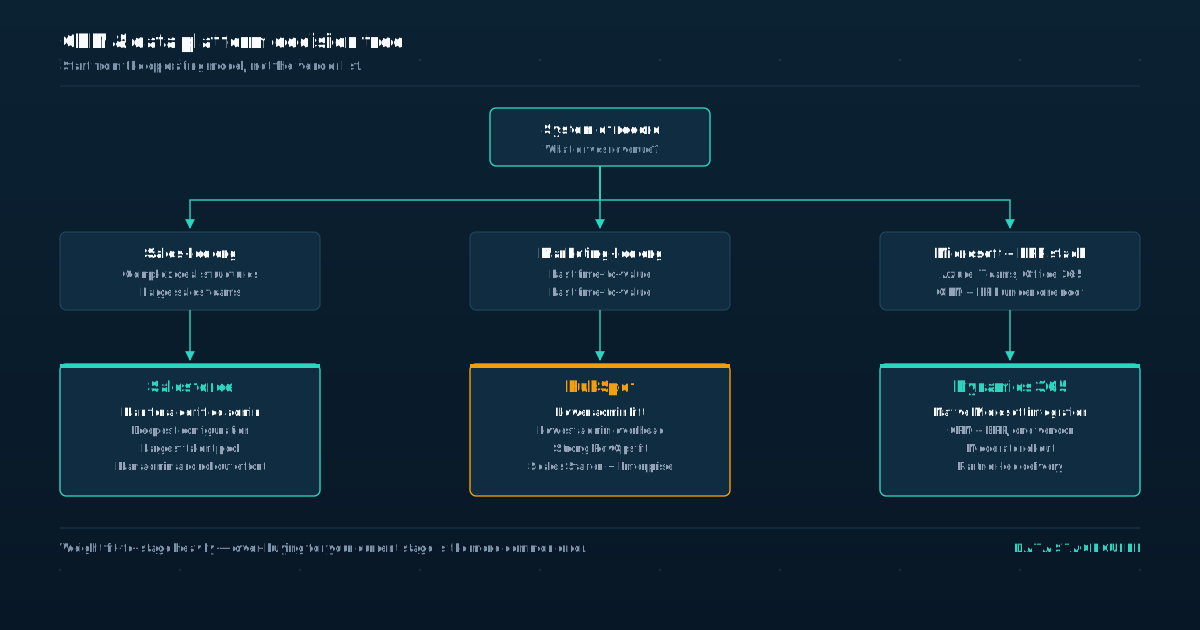
Set a Review Cadence After You Sign
The bakeoff does not end when you sign the contract. Data quality degrades over time, and vendor performance can shift as their data sources change or their matching algorithms get updated.
A vendor that looked great in the bakeoff might slide over the course of a year, and you will not know unless you are checking.
- Pull records enriched in the previous quarter and manually verify a sample of them.
- Track accuracy and match rate trends over time.
- If accuracy drops below your contractual threshold, you have grounds for renegotiation or exit.
Run a mini-bakeoff every quarter. Without quarterly checks, you will discover problems at renewal when it is too late to do anything about them. Keep your bakeoff scorecard updated. When renewal time comes, you will have months of performance data instead of relying on a single point-in-time test.
This puts you in a stronger negotiating position and helps you decide whether to renew, renegotiate, or switch vendors entirely. A vendor that won the initial bakeoff but has been sliding for two quarters should not get an automatic renewal. Document what you learned.
The next time your company runs a vendor evaluation for any tool, not just data, the bakeoff framework transfers.
The principle is the same: test with real data, score objectively, negotiate with evidence. Set up automated monitoring where possible. If your CRM integration runs on a schedule, build a report that tracks match rates and fill rates by month.
A sudden drop in match rate is an early signal that something changed on the vendor side.
Catching it early gives you time to investigate and raise it with your account manager before it becomes a bigger problem.
Make the Decision and Move
You have the test file results, the scorecard, the integration test, and the negotiation data. Now make the call. The biggest mistake teams make at this stage is overthinking the decision.
- If one vendor scored meaningfully higher on the dimensions you weighted most heavily, pick them.
- If two vendors are close, let price and integration quality break the tie.
- Waiting for perfect data means waiting forever, and your team needs a tool in place to do its job.
No vendor will win every dimension. The goal of the bakeoff is to reduce uncertainty, not eliminate it. You are choosing the provider that fits your use case best, not the provider that is best in absolute terms. A vendor that dominates on enterprise contacts might be the wrong pick if you sell to mid-market.
A vendor with slightly lower match rates but much higher accuracy might be the right pick if your reps are burning out on dead numbers. Context drives the decision. Communicate the decision clearly to stakeholders. Share the final scorecard, explain the weights, and walk through the reasoning.
People who understand the methodology are less likely to challenge the outcome. People who were not included in the process are more likely to second-guess it later, so bring them along before the announcement, not after. Set a calendar reminder for your first quarterly review. The bakeoff framework only works if you keep running it.
Data quality is not a one-time check. It is an ongoing discipline. The teams that get the most value from their data vendors are the ones that treat vendor performance as something to monitor continuously, not something to evaluate once at purchase and forget. The upfront work is done.
The ongoing work is what protects the investment over the life of the contract.
Tools Mentioned in This Guide
Related Categories
Sources
Frequently Asked Questions
How many records should I include in a vendor bakeoff test?
A few hundred records is the sweet spot. Too few and statistical noise makes the results unreliable. Too many and vendors start pushing back on free testing.
Split your file into known-good records, records with gaps, and net-new targets to measure three distinct capabilities.
How long should a data vendor bakeoff take?
Two to three weeks from sending test files to final decision.
Allow a week for vendors to return matched results, a few days for your team to verify accuracy and build the scorecard, and a few days for stakeholder review and vendor negotiations.
Will data vendors participate in a bakeoff for free?
Yes. Every major provider offers free data tests for qualified prospects. It is standard practice. If a vendor refuses to test against your data, treat that as a disqualifying signal.
Should I tell vendors they are in a competitive bakeoff?
Yes, always. Being transparent about the competitive evaluation motivates vendors to deliver their best results and respond faster. It also sets the expectation that you are making a data-driven decision, which helps when you negotiate pricing later.