B2B Contact Database Providers (2026)
The best B2B contact database provider depends less on brand recognition and more on the market you sell into. A provider that works for US SaaS outbound can disappoint a team selling into healthcare, Europe, public sector, or owner-operated SMBs. This guide gives you a clear evaluation path. When you search for a B2B contact database provider, you need data that matches your specific buyer profile, territory, and compliance requirements. Not all providers cover every industry or region with the same accuracy. Some excel at tech contacts in North America, while others offer stronger coverage for manufacturing in Germany or decision makers in government. Your choice should start with your target market, not the provider's total record count. This guide compares the top B2B contact database providers for 2026. We focus on data freshness, filtering options, pricing models, and compliance standards. You will learn how to test providers against your actual ICP before committing. Whether you need phone numbers, email addresses, or intent signals, the right provider depends on where and whom you sell to.
How to compare B2B contact database providers by coverage, pricing, phone quality, CRM fit, compliance, and use case.
What Contact Database Providers Actually Sell
A contact database provider sells access to a structured list of business people and the companies they work for. The core product is a set of fields: name, title, company name, company size, industry, phone number, and email address.
- But the real difference between providers is not the fields themselves, it is how fresh the data is and how you are allowed to use it.
- Apollo, for example, offers a large volume of contacts at a low price, but many of those emails are inferred and may bounce.
- ZoomInfo prices itself higher and guarantees a higher accuracy rate on direct dials and corporate emails, but it also locks you into annual contracts with strict usage limits.
Cognism focuses on European GDPR compliance and offers a separate phone-verified dataset. Lusha and LeadIQ are lighter tools that work as browser extensions, good for small teams that need quick lookups but not for bulk enrichment. A common mistake buyers make is comparing only the total contact count.
You should ask for a sample export of a focused contact sample from your target industry and run a verification tool like ZeroBounce or NeverBounce before signing. Another mistake is ignoring the export policy. Some providers let you download contacts and keep them forever after a subscription ends.
Others, like ZoomInfo, require you to delete all data if you cancel. That lock-in matters if you plan to build a long-term CRM list. The tradeoff comes down to volume versus accuracy versus price.
If you are building a permanent sales database for enterprise account-based selling, paying for ZoomInfo or Cognism saves you time and reputation damage from bad emails. The decision rule is simple: test the data on your actual target list before committing to a year.
Provider Types and Where They Fit
The simplest way to separate providers is by their core data model. Apollo and ZoomInfo build massive, all-in-one databases that try to cover every company and contact in one subscription. You pay a flat annual fee and get access to everything they have, which works well if you need broad coverage across many industries.
- Cognism and Lusha take a different approach, focusing on verified direct dials and mobile numbers for specific regions, often Europe for Cognism and global mobile coverage for Lusha.
- LeadIQ sits in a third category as a sales engagement tool that captures data from your own prospecting workflows rather than offering a pre-built database.
- The mistake most buyers make is picking a provider based on total record count instead of fit for their specific sales motion.
If your team cold calls heavily into enterprise accounts, ZoomInfo's direct dial coverage is hard to beat, but you will pay for thousands of records you never use. If you target European SMBs with email sequences, Cognism's GDPR-compliant mobile numbers will give you better connect rates than a cheaper Apollo plan.
Lusha and LeadIQ offer usage-based credits that scale down for small teams. A practical decision rule is to match the provider's strength to your primary channel. For outbound calling, prioritize providers with verified mobile numbers and real-time verification, even if the total contact count is lower.
For email-heavy sequences, a larger database with decent accuracy, like Apollo, can work if you invest in a separate verification tool. The tradeoff is always between breadth and accuracy. A smaller, verified list from Cognism or Lusha will outperform a massive, unverified export from a generalist provider in terms of reply rates and bounce reduction.
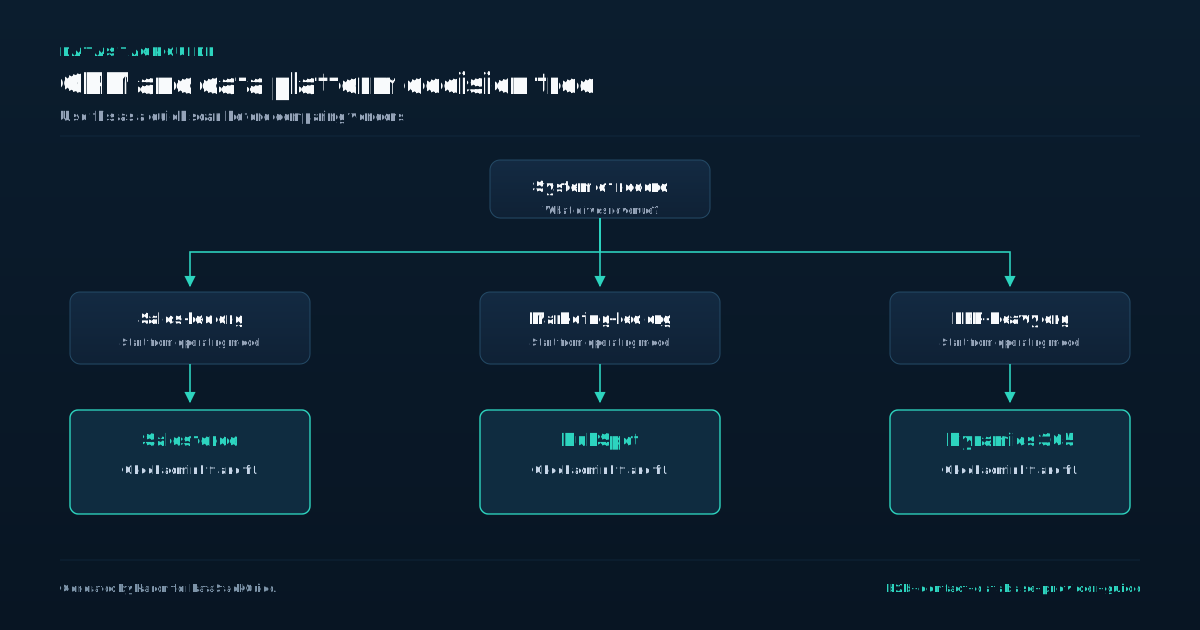
Coverage Questions to Ask Before a Demo
Before you sit through a demo, ask the provider for a coverage report on your top three target accounts. Pick accounts you know well: one where you have existing contacts, one where you have none, and one in a niche vertical like industrial manufacturing or local government.
- Run those accounts through the provider's database yourself if they offer a free trial, or ask the sales rep to pull a live count during the call.
- The number of contacts per account tells you nothing useful on its own.
- What matters is the ratio of direct dials to generic switchboards, the recency of the last verified email bounce, and whether the titles match the actual decision-makers you need.
A provider that shows a small target list for a 500-person company but lists them all as "manager" is hiding thin coverage. A common mistake is comparing providers by total record count. Instead, ask for a sample export of a small sample from your ideal customer profile.
Check how many emails bounce within a short trial window and how many phone numbers ring to the right person. Lusha and LeadIQ often score well on small-batch accuracy but thin out on enterprise depth.
The tradeoff is clear: broad databases give you volume for prospecting at scale, while curated providers give you higher connect rates for targeted outreach. Set a decision rule before the demo.
If they cannot provide a direct dial for at least one person per account in your niche vertical, that gap will cost your team hours of manual research. Coverage is not about how many contacts they have. It is about how many of those contacts you can actually reach and convert into a conversation.
How to Compare Data Quality Fairly
Comparing data quality fairly means looking past the vanity metrics vendors advertise. A better test is to run a sample of a small sample from your actual target accounts through each provider. Check how many contacts have verified phone numbers, how many emails bounce, and how many job titles match what you need.
- The biggest mistake buyers make is comparing providers on total record count instead of match rate against their ICP.
- LeadIQ pricing often includes direct integration with your CRM, which can surface data decay faster than a bulk provider like Cognism.
- Lusha pricing is attractive for small teams, but their coverage on senior titles in enterprise accounts is thinner than ZoomInfo or Cognism.
Always ask each vendor for a match rate report on your specific list of target companies before signing. Tradeoffs matter more than feature lists. A provider with strong intent data may have weaker firmographic filters. One with cheap bulk exports may lack real time verification.
Your decision rule should be: pick the provider that minimizes the total time your reps spend correcting bad data. Run a two week trial with your top three candidates, measure usable contacts per dollar, and ignore any metric that doesn't tie directly to a rep picking up the phone.
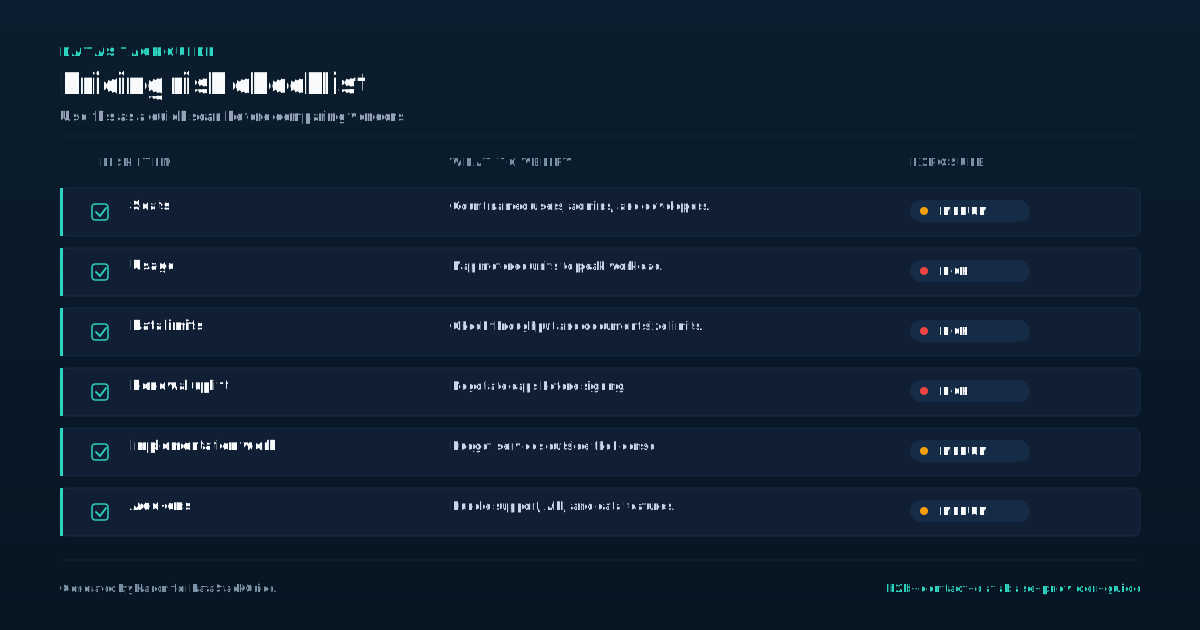
Pricing Models and Credit Traps
Pricing among B2B contact database providers follows three broad models, and each hides a credit trap. Apollo and ZoomInfo charge per seat with a monthly credit allowance for exports. Cognism and Lusha offer usage-based plans where you buy a pool of credits.
- The mistake buyers make is assuming one credit equals one contact.
- In practice, a single enriched record can cost two or three credits if the provider pulls a direct dial, a mobile number, and a verified email.
- A 5,000-credit plan might yield only 1,500 usable contacts.
LeadIQ ties credits to sales engagement actions. The real cost surfaces when you factor in waste. Most providers deduct credits for bounced emails, outdated numbers, or duplicate records. ZoomInfo's standard terms do not refund credits on bad data.
Apollo's free tier gives limited credits but charges full price for overages. Cognism offers a data accuracy guarantee that replaces bad contacts without consuming extra credits, but only on certain plans. To avoid overpaying, calculate your effective cost per delivered contact. Divide the monthly subscription by the number of verified, deliverable records you actually use.
Compare that number across providers. Also check whether credits expire monthly or roll over. Usage-based plans from Lusha and LeadIQ let you pause spending, while seat-based contracts from ZoomInfo lock you into annual commitments. Pick the model that matches your sales team's actual output, not the one with the lowest headline price.
CRM and RevOps Requirements
CRM and RevOps teams often buy a contact database without first mapping how the data will move into their existing stack. The most common mistake is choosing a provider based on raw record count, then discovering that the API only supports basic fields while your Salesforce instance requires 12 custom objects to route leads correctly.
- Before you evaluate Apollo pricing or ZoomInfo pricing page, audit your current CRM fields, enrichment triggers, and deduplication rules.
- A practical decision rule is to test the provider's integration with your actual workflow, not their demo environment.
- Run a 50-record import through your CRM and check how many fields map automatically versus requiring manual mapping.
If your RevOps team uses lead scoring based on technographic data, a provider like Cognism that offers intent signals and firmographic filters may save weeks of manual cleanup, whereas Lusha or LeadIQ might be better suited for teams that only need phone numbers and direct emails for outbound sequences.
If your team uses HubSpot's native enrichment, verify that the provider's API respects your existing duplicate management settings. Tradeoffs appear quickly: a provider with deep firmographic data often charges per enriched record, while a flat-rate plan may limit API calls per day.
For example, ZoomInfo's API rate limits can stall a high-volume sales development team, whereas Cognism's per-seat pricing might be cheaper for a small RevOps group but expensive at scale. The final requirement is compliance. Your CRM must log consent status for each contact, and the provider should offer a clear data sourcing policy.
If your RevOps team operates in Europe or serves EU customers, check whether the provider's data is sourced from public records or third-party brokers. Lusha and LeadIQ both provide GDPR-compliant fields, but their coverage in certain industries varies.
Any provider that cannot meet that bar will create more work for your CRM team than it saves.
Which Provider Fits Each Team Type
A team of two to five sales reps needs a provider that keeps costs low while delivering reliable direct dials and email addresses. The tradeoff is data accuracy; Apollo's database is large but contains more outdated records than premium alternatives, so reps must verify contacts before sending outreach.
- For early-stage teams, the decision rule is simple: prioritize budget and tool consolidation over data perfection.
- Mid-market sales teams with 20 to 100 reps face a different set of tradeoffs.
- These teams need higher data accuracy to protect sender reputation and avoid wasted activity, but they also require flexible pricing that scales with headcount.
Cognism offers similar pricing but includes stronger GDPR compliance features, making it the better choice for teams selling into Europe. The mistake here is choosing a provider based on total record count rather than match rate on your specific target accounts.
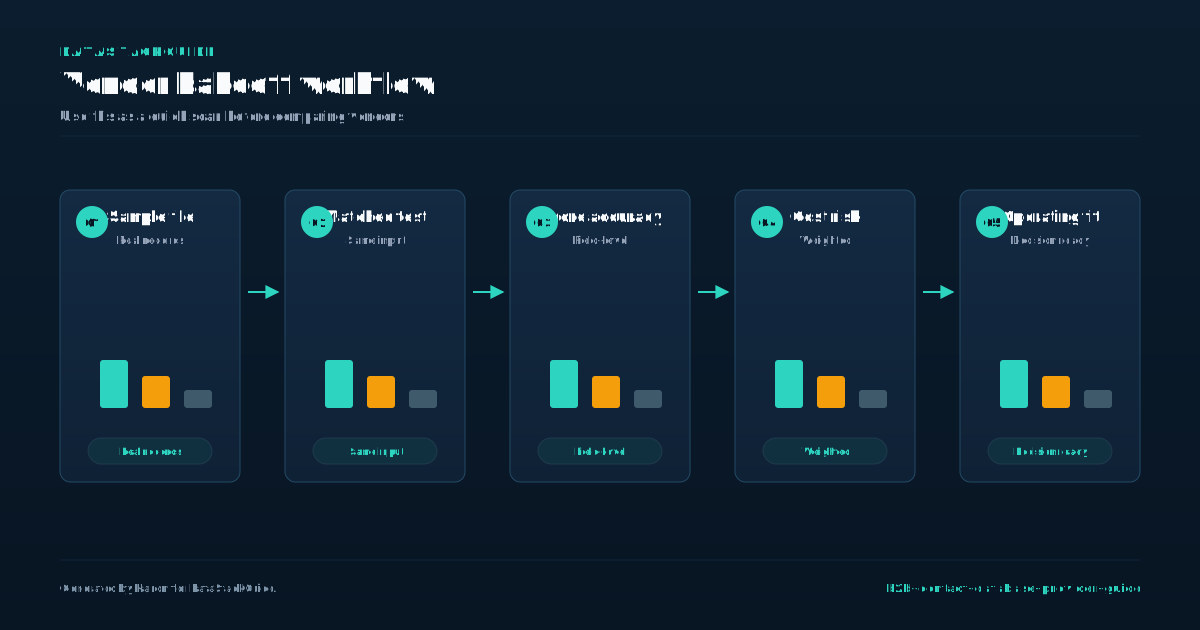
A team selling to enterprise CFOs should test each provider against a list of 50 known contacts and compare how many return valid direct dials. The decision rule is to run a 50-contact audit before signing any contract.
Enterprise sales organizations with over 100 reps need providers that integrate directly with their CRM and enforce data governance rules. Lusha and LeadIQ both offer Chrome extensions that let reps capture contacts from LinkedIn and company websites, but their pricing differs in structure.
The tradeoff is control; Lusha gives finance teams predictable spend, while LeadIQ gives sales leaders predictable usage. A common enterprise mistake is buying a single provider for the whole org without segmenting by region or vertical.
A global team might use ZoomInfo for North American accounts and Cognism for European accounts to stay compliant with local data laws. The decision rule is to negotiate a hybrid contract that allows different teams to use different providers under one master agreement.
Provider Evaluation Checklist
Start with data coverage, not price. Check their coverage by industry, company size, and geography before you compare monthly fees. Apollo's pricing starts low but you pay extra for email credits and intent data.
- ZoomInfo's base tier includes more fields but costs three times as much.
- Cognism runs heavy on EMEA coverage while Lusha and LeadIQ lean North American.
- The mistake is picking a tool based on a demo of your own company.
Instead, test each provider against five real prospects in your target account list. Run the same search on each platform and count how many direct dials and verified emails you get back. Data freshness is the hidden cost. A contact that was valid six months ago is often a bounced email and a wasted sequence.
ZoomInfo and Cognism both publish refresh cadences, but you need to check how often they re-verify existing records versus just adding new ones. Apollo re-verifies on export, which sounds good but can slow down your workflow. LeadIQ integrates directly with your CRM to flag stale data during outreach.
The tradeoff is between a large stale database and a smaller clean one. Integration depth determines real ROI. A contact database that requires manual CSV uploads will die on your sales team's desk. Check native syncs with your CRM, your sequencing tool, and your enrichment API.
Lusha offers a Chrome extension for one-click lookups, which works for small teams but breaks at scale. ZoomInfo's API is the most flexible for custom workflows but demands engineering time to set up. Cognism and LeadIQ both push data directly into Salesforce or HubSpot on contact creation.
The rule is simple: if your reps have to open a second tab to use the tool, they will stop using it within two weeks.
Tools Mentioned in This Guide
Related Categories
Sources
Frequently Asked Questions
Who are the main B2B contact database providers?
The main B2B contact database providers are ZoomInfo, Lusha, Apollo. io, UpLead, and Cognism. ZoomInfo offers a large database with firmographic and intent data. Lusha focuses on direct contact details with high accuracy.
Apollo. io combines a database with sales engagement tools. UpLead provides verified data with real-time email verification. Cognism specializes in GDPR-compliant data for European markets.
How do B2B contact database providers price access?
B2B contact database providers typically price access through annual subscriptions based on user seats and credit limits. Credits are consumed per contact record or email verified. Some providers offer pay-as-you-go credits or custom enterprise pricing.
Always compare cost per usable contact, not total record count.
Which provider is best for phone numbers?
For direct dial phone numbers, ZoomInfo is the strongest choice. Lusha offers a cheaper alternative for individual lookups, but its volume and verification rates are lower. For international coverage, Cognism provides strong European mobile data.
Always test a sample against your existing records before committing to a provider.
What should I test before buying a provider?
Test data accuracy by running 50 sample records against your CRM. Verify email deliverability with a small send. Check phone number validity with a dial test. Confirm firmographic fields like revenue and employee count match your ICP.
Assess update frequency by rechecking records after a short trial window. Review compliance with GDPR and CAN-SPAM. Request a trial to test integration speed with your sales tools.
What is a B2B contact database provider?
A B2B contact database provider is a company that compiles and sells structured lists of business professionals and companies. These databases include details like names, job titles, company names, email addresses, and phone numbers.
Businesses use these providers to find sales leads, build targeted marketing lists, and support account-based marketing. Examples include ZoomInfo, Lusha, and Apollo. io. Providers differ in data accuracy, coverage, pricing, and enrichment features.